Free Shipping – Store Wide
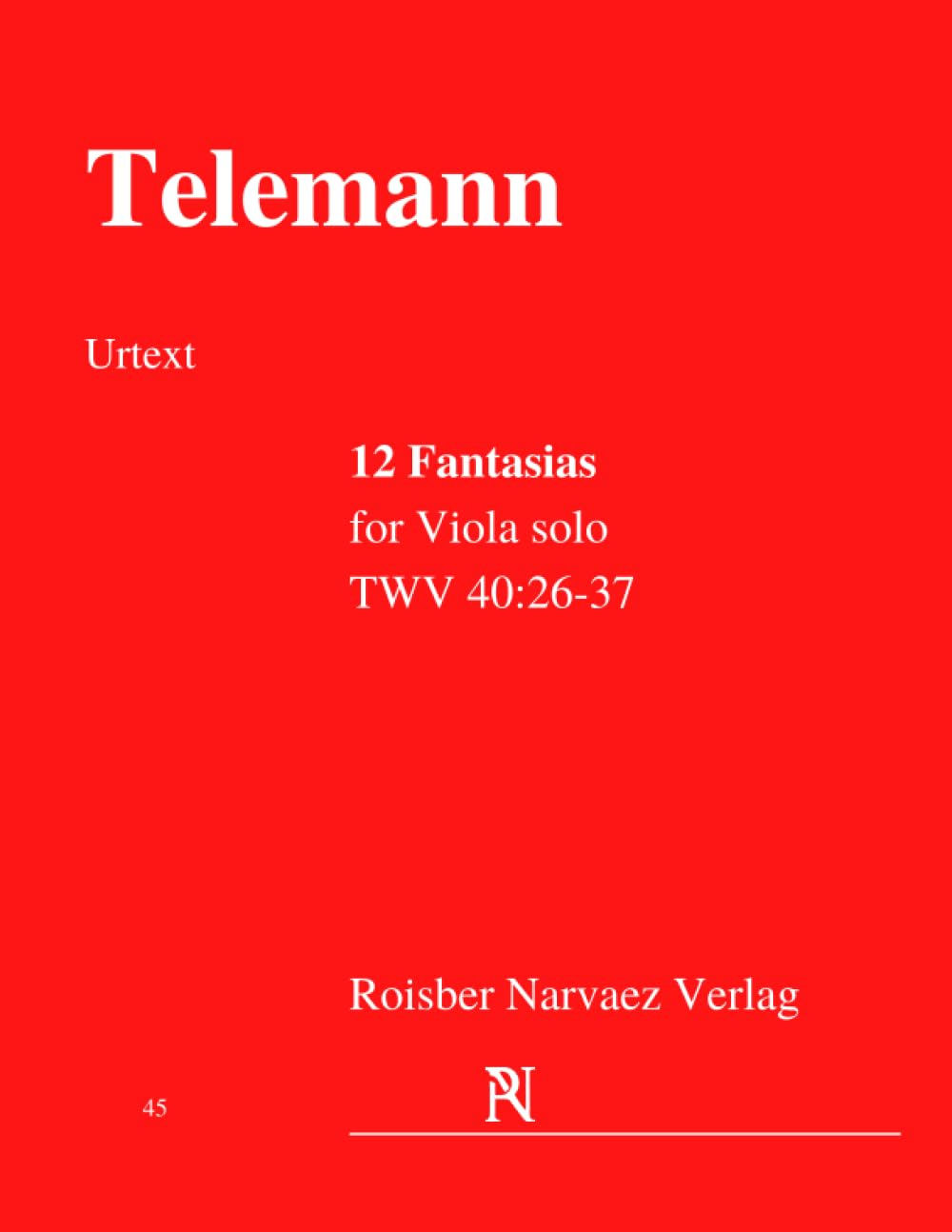
12 Fantasias for Viola Solo: TWV 40:26-37: (Arranged for Viola)
12 Fantasias for Viola Solo: TWV 40:26-37: (Arranged for Viola)
A$43.40
The German composer Georg Philipp Telemann (1681-1767), between 1727 and 1735 is probably his most prolific period for the creation of works for unaccompanied instrument, the 12 Fantasies for solo flute (around 1727), Fantaisies pour le Clavessin (1732/33) or the Fantasies for violin (1735). The Fantasies are possibly works that Telemann perhaps understood to be conceived for a single performer and he makes use of all variants of the form with the sequence of movements fast - slow - fast, the form stretta slow - fast - fast.
The 12 Fantasias presented in this volume have been arranged and transcribed by Roisber Narvaez for Viola solo, adapted directly from the published engraving of 1735 by Telemann's own publisher in Hamburg in 1735 and were considered lost until a perfectly preserved original print was found in a private library in Ledenburg Palace, Despite the fact that many of the works have never been known and several of the manuscripts were lost during the Second World War, this priceless find is of enormous value to music and provides an opportunity to further study and analyse baroque style and technique. The engraver's title page of the first edition reads: FANTAISIES pour la BASSE de VIOLLE, faites et dediées à Mr. Pierre Chaunell, par Telemann. This clearly indicates that they are part of a group of unaccompanied works, in this case for Viola da gamba. In the first edition of the 12 fantasias, the layout, appearance of the title page and the punctuated pages show features typical of Telemann's publications. In comparison to the solo fantasias for the flute and for the violin, the composer made a dedication to Pierre Chaunell (1703-1789), a banker and businessman from Hamburg, who was known to have bought several of Telemann's works. The dedication underlines the good connections between the two, as it was a significant gesture of friendship and goodwill; it is not known whether Chaunell himself played the Viola da gamba. However, Chaunell was one of the subscribers to the Musique de table in 1733 [Musique de table de Telemann, table de ceux qui ont souscrit à l'ouvrage. Gallica-BnF], which are basically collections of varied music (anthologies), pieces intended to accompany meals that could be performed by amateurs because they do not present any particular difficulty, being one of the most monumental sets of scores of the late Baroque.
In our book RN Verlag, we have made an adaptation preserving the bowings of the composer, respecting his philosophy and remaining faithful to the musical text, except for those exceptions of chords or double stops that are not possible to play on the Viola in the arrangement originally written, however, in some places we have chosen to change the inversion of the chord so that it is possible to play it. In certain phrases that have a low register, we have preferred an octave up, but not in random places, but respecting the movement by scale degree and rather when there are interval breaks prior to the phrase to be adapted, so as not to affect the musical direction, since the Viola da gamba has a register almost an octave lower than the viola and despite the similarity between the two instruments in sound range, There is a small section of tessitura that does not remain within the interpretative possibilities of the viola and this obliges us to make small modifications at the time of the adaptation and arrangement, even the separation and union of the stems have been conserved, as it could be understood that this would make some sense for the interpreter.
The 12 Fantasias presented in this volume have been arranged and transcribed by Roisber Narvaez for Viola solo, adapted directly from the published engraving of 1735 by Telemann's own publisher in Hamburg in 1735 and were considered lost until a perfectly preserved original print was found in a private library in Ledenburg Palace, Despite the fact that many of the works have never been known and several of the manuscripts were lost during the Second World War, this priceless find is of enormous value to music and provides an opportunity to further study and analyse baroque style and technique. The engraver's title page of the first edition reads: FANTAISIES pour la BASSE de VIOLLE, faites et dediées à Mr. Pierre Chaunell, par Telemann. This clearly indicates that they are part of a group of unaccompanied works, in this case for Viola da gamba. In the first edition of the 12 fantasias, the layout, appearance of the title page and the punctuated pages show features typical of Telemann's publications. In comparison to the solo fantasias for the flute and for the violin, the composer made a dedication to Pierre Chaunell (1703-1789), a banker and businessman from Hamburg, who was known to have bought several of Telemann's works. The dedication underlines the good connections between the two, as it was a significant gesture of friendship and goodwill; it is not known whether Chaunell himself played the Viola da gamba. However, Chaunell was one of the subscribers to the Musique de table in 1733 [Musique de table de Telemann, table de ceux qui ont souscrit à l'ouvrage. Gallica-BnF], which are basically collections of varied music (anthologies), pieces intended to accompany meals that could be performed by amateurs because they do not present any particular difficulty, being one of the most monumental sets of scores of the late Baroque.
In our book RN Verlag, we have made an adaptation preserving the bowings of the composer, respecting his philosophy and remaining faithful to the musical text, except for those exceptions of chords or double stops that are not possible to play on the Viola in the arrangement originally written, however, in some places we have chosen to change the inversion of the chord so that it is possible to play it. In certain phrases that have a low register, we have preferred an octave up, but not in random places, but respecting the movement by scale degree and rather when there are interval breaks prior to the phrase to be adapted, so as not to affect the musical direction, since the Viola da gamba has a register almost an octave lower than the viola and despite the similarity between the two instruments in sound range, There is a small section of tessitura that does not remain within the interpretative possibilities of the viola and this obliges us to make small modifications at the time of the adaptation and arrangement, even the separation and union of the stems have been conserved, as it could be understood that this would make some sense for the interpreter.
- Publisher: Independently published (12 June 2023)
- Paperback: 35 pages
- Dimensions: 21.59 x 0.2 x 27.94 cm
- Language: English
- Book Type: Paperback
- ISBN-13: 979-8397163767
A$43.40
Shipping to Australia
Delivery time varies by location
Return & Refund Policy
Check our return & refund policy
Security & Privacy
Safe payments: We do not share your personal details
Availability:
-
In Stock
Sign in
or create an eMega account
Shop smarter — get exclusive deals & order tracking