Free Shipping – Store Wide
Ludford Missa Videte Miraculum
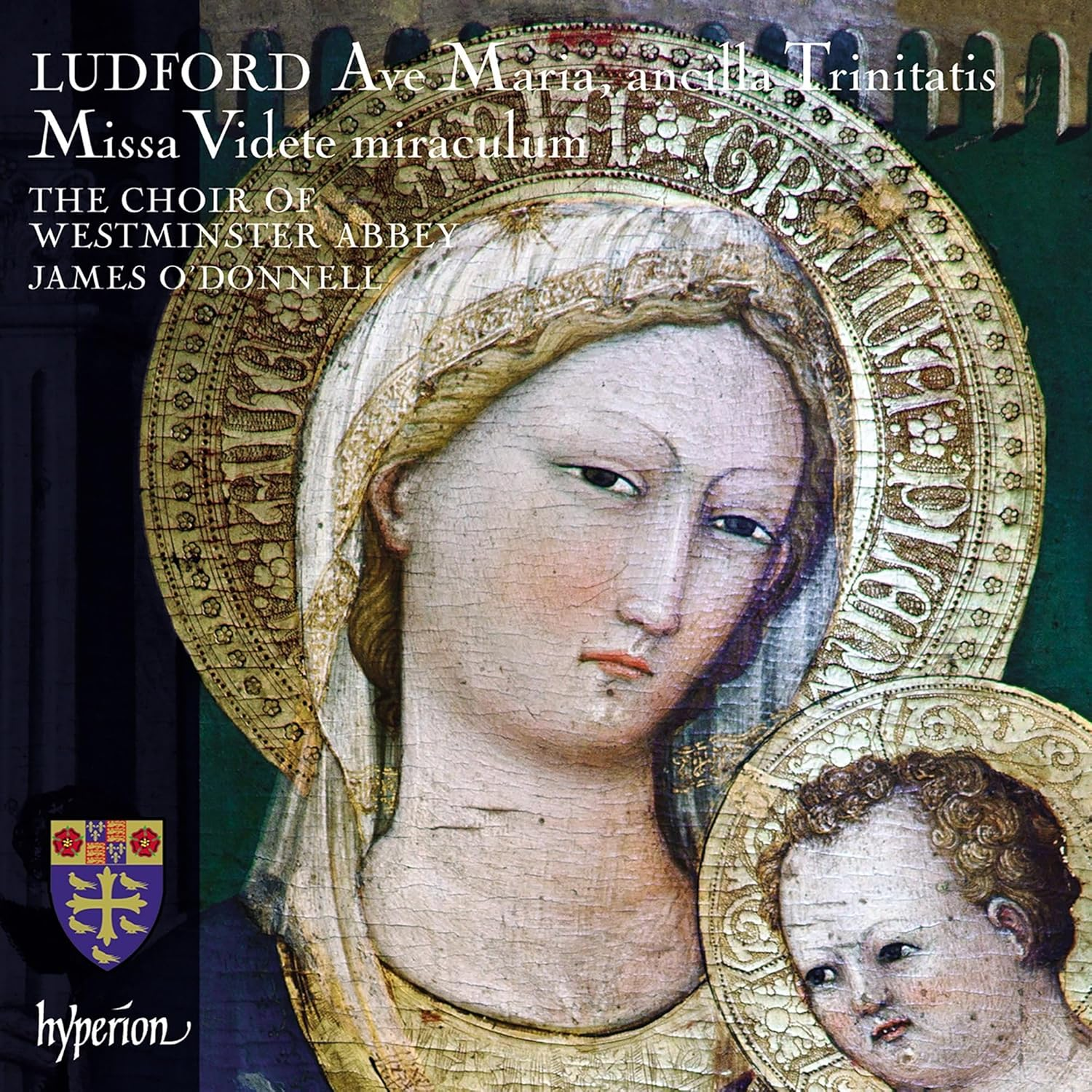
Ludford Missa Videte Miraculum
Brand: HARMONIA MUNDI
A$45.80
Availability:
-
This item is currently not available
Shop with confidence
In the final years of Mary Tudor’s short reign, a potent distemper was taking grip across England; an illness which would claim the lives of over five per cent of the population, including prominent composers, politicians, clerics, and perhaps even the Queen herself. Writing his will in March 1557, the ageing composer Nicholas Ludford may well have reflected with both despondency and considerable satisfaction on a life he had spent at the epicentre of English musical and religious ceremony over a period encompassing the greatest ecclesiastical and political upheavals in the country’s history. These were the final months of Mary’s Catholic revival and, approaching his deathbed, Ludford characterized his credence through an unwavering affinity with the past he had served devoutly as verger and organist at St Stephen’s Chapel in the Royal Palace of Westminster, by bequeathing his soul ‘unto allmyghtye god … through the merytyes and passion of oure lorde Iesu Chryste and to hys Blessyd mother Sayncte marye and all the holly company of heven’.
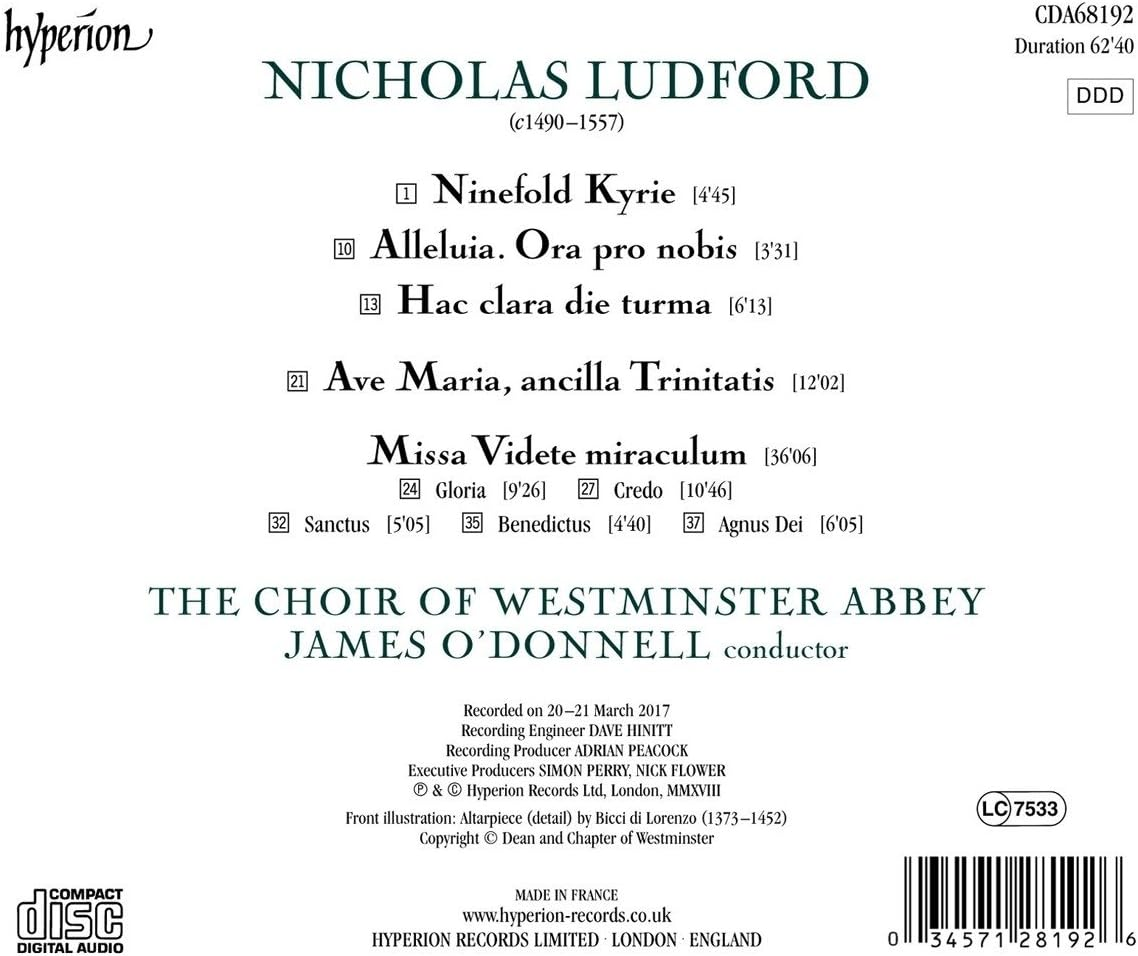
Such devotion to ‘Sayncte marye’ echoes the intensity of the English Cult of Mary, which reached its apogee during the period of Ludford’s employment in Westminster. Indeed, votive liturgy to Mary would have occupied the major part of Ludford’s musical activity here. Accordingly, the present collection represents three archetypes of English sacred polyphony expressed in Marian worship: the daily Lady Mass (tracks 1-20), the votive antiphon (tracks 21-23) and the festal Mass for a Marian feast (tracks 24-39). Whilst the music here was likely composed for use at the Royal Palace, the shared employment of singers and the movement of choirs and organists between institutions in Westminster suggest that the same music may have been performed at St Margaret’s Church or in the Lady Chapel of Westminster Abbey itself.
Ludford was resident in Westminster by 1517 and is recorded at St Stephen’s in 1524 with his formal contract of employment dated 30 September 1527. Around this time, Ludford established permanent residence on Longwolstable Street, immediately north of the Palace walls, roughly on the site of the iconic Elizabeth Tower (which houses ‘Big Ben’). Following the dissolution of the college and chapel in 1547, the employees of St Stephen’s were pensioned off, and Ludford was able to fortify his connections with the Parish Church of St Margaret (in the shadow of the Abbey and St Stephen’s) where he and his wife had hired a pew since 1525. Ludford became churchwarden here for a two-year period from May 1552, and following his death in August 1557, was buried close to his first wife Anne, in the vaults of the church. A little more than a year later, the same setting would provide the resting place for fellow composer John Sheppard (c1515-1558), and in 1574, for Robert White (c1538-1574).
The chronology of Ludford’s œuvre is not straightforward, though it’s likely that his surviving music was all composed prior to 1530, thus providing a useful connection between the earlier style of Robert Fayrfax (1464-1521) and the progressive John Taverner (c1490-1545) and John Sheppard. Ludford’s music is perhaps more florid and melismatic than that of Fayrfax, and the composer is particularly attentive to the control of timbre and variety through alternating combinations of vocal groups. For Tudor composers, the management of voices through the daily liturgy conceals a potential dichotomy: the demand for an ornate, elaborate musical style on the one hand, and an obligation to nurse the stamina of singers (particularly trebles) on the other. Of course, much pre-Reformation church music already belonged to a culture of ‘alternatim’ performance, where plainchant and polyphonic verses are exchanged between distinct groups of singers or soloists. But the demand for ornate polyphonic music had grown in conjunction with the development of Lady Chapel choirs serving the daily Lady Mass, and so it was inevitable that a distinct style of polyphony would evolve—one that attended to both of these demands. With its doubled choruses of principals emulating the choir, the Tudor organ was central to this development, and by the start of the sixteenth century was performing a significant role in the Lady Mass at major institutions across the country. For example, in 1502, on the death of Prince Arthur (Henry VII’s eldest son) at Ludlow: ‘the Bishop of Chester song our Ladye’s Masse, which was song with children, and prickt songue [written polyphony] with organes.’ The significance of the organ at St Stephen’s is evident from the dissolution inventory which records ‘iij payer of organs in the upper chapell’ and ‘one old payer of organs in the nether chapell’.
Rhythmic melodies known as ‘squares’ were assembled over the course of the fifteenth and early sixteenth centuries to provide memorable musical material for such regular services. These melodies were extracted from earlier polyphonic compositions, recycled, and arranged to facilitate the performance of the daily ferial Mass, cultivating ‘alternatim’ performance practices between vocal polyphony (in three parts), and organist, who would improvise alternate versets ‘upon the square’. The survival of a complete cycle of seven Lady Masses by Ludford (in four partbooks now in the British Library) is unique. Ludford employs a distinct Kyrie ‘square’ for each Mass (for the Ordinary items), with a soloist’s partbook providing alternating monophonic versets upon which to improvise (Kyrie, Gloria, Credo) at the organ, together with the relevant plainchant, which was either sung or played. The leather binding of these partbooks is embossed with the arms of Henry VIII and Catherine of Aragon, and the books were catalogued in the Royal Library at Westminster as early as 1542 (‘Bookes of priksong masses foure’), strengthening their association with the Royal Palace.
The Kyrie ‘square’ used by Ludford for his Tuesday Mass (Feria iii), has a complex history, being extracted from a chanson twice attributed to Dufay in continental sources: Or me veult bien Esperance mentir. Numerous survivals, including some keyboard versets designated ‘Kyrie’, attest to the popularity of this ‘square’ across England, and one such example provides music for the first and third verse in the present recording. Contemporaneous sources such as this appear to crystallize an improvised language for two-voice ‘bicinia’ upon the square, and have informed the modern invention of the remaining versets to complete the alternating organ/choir structure of this ninefold Kyrie.
In addition to the Mass Ordinary items ‘upon the square’, Ludford provides the music for the Proper cycles. The Alleluia and the Sequence are each based here on their customary Sarum plainchants, though now alternating the vocal chant led from the soloist’s partbook with two- or three-part polyphony. ‘Alleluia. Ora pro nobis’ is attached to the same Tuesday Mass (Feria iii) as the Kyrie, and the Sequence ‘Hac clara die turma’ is that designated for Thursday (Feria v). The regular Offertory ‘Felix namque’ and Communion ‘Beata viscera’ also appear in the soloist’s book, where they would have provided the basis for organ improvisation, or vocal plainchant at the designated place later in the Mass.
The jewel in the crown of late-medieval English polyphony is undoubtedly the repertory of votive antiphons to be sung at the conclusion of Compline at the end of the day, and represented most lavishly through the music of the Eton Choirbook. Whilst Ludford was too young to feature in this great collection, we are fortunate for the survival of the Peterhouse Partbooks (Cambridge, University Library, Peterhouse MSS 471-74) which, despite missing a tenor book, enable the reconstruction of a number of Ludford’s Marian works. One of these, Ave Maria, ancilla Trinitatis, is based on a prayer found in some fifteenth-century primers. Each li
- Number of discs: 1
- Original Release Date: 2018
- Product dimensions: 14.2 x 12.78 x 0.94 cm; 99.79 Grams
- Label: HARMONIA MUNDI
- Book Type: Audio CD, Import, 2 March 2018
- Manufacturer: HARMONIA MUNDI
A$45.80
Shipping to Australia
Delivery time varies by location
Return & Refund Policy
Check our return & refund policy
Security & Privacy
Safe payments: We do not share your personal details
Availability:
-
This item is currently not available
Sign in
or create an eMega account
Shop smarter — get exclusive deals & order tracking