Free Shipping – Store Wide
The Software-To-Hardware Playbook: Mastering FPGA Programming with High-Level Synthesis, C++, and Rust.
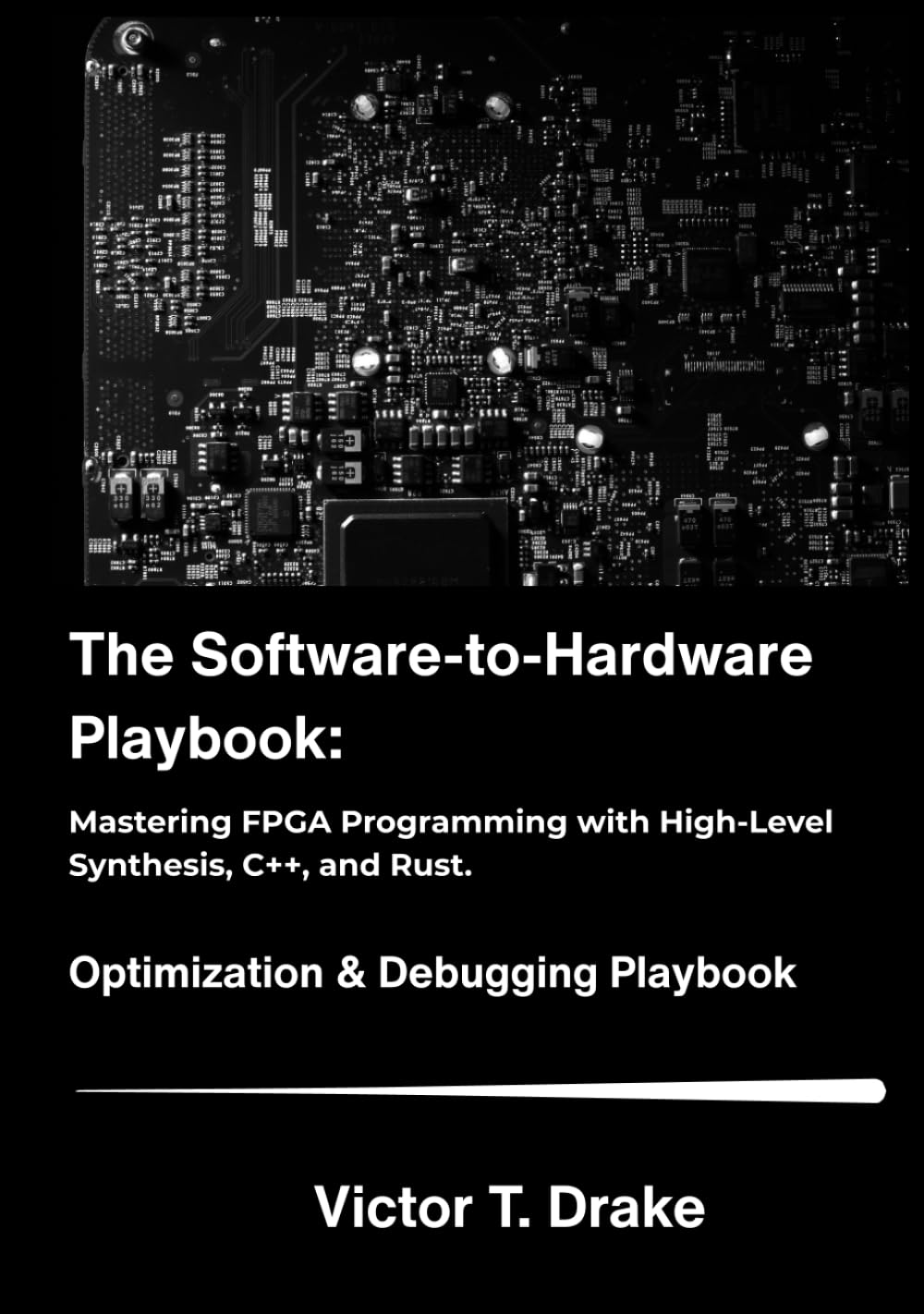
The Software-To-Hardware Playbook: Mastering FPGA Programming with High-Level Synthesis, C++, and Rust.
A$40.70
-
A$66.15
Availability:
-
Select Styles for Availability
Shop with confidence
The era of "free lunch" performance is over. Your CPU is the bottleneck, and no amount of code optimization can save you.
For decades, software engineers lived by a simple contract: write the code, and the hardware manufacturers will make it run faster. That contract is broken. Moore’s Law has slowed, and the demands of modern computing—High-Frequency Trading, Real-Time AI, and 100Gbps Networking—have outpaced the physical capabilities of the General Purpose Processor.
To break the speed limit, you must leave the CPU behind. You must move your logic directly onto the silicon.
The Software-to-Hardware Playbook is the definitive guide for the modern software engineer who wants to cross the divide. It rejects the notion that you need to spend years learning Verilog or VHDL to build high-performance hardware. Instead, it hands you the tools to architect custom processors using the languages you already master: C++ and Rust.
This is not a textbook on circuit theory. It is a tactical manual for the "Full-Stack" engineer of the future. It strips away the academic fluff and focuses on the pragmatic strategies—the "plays"—required to take an algorithm from a slow sequential loop to a blazing-fast, pipelined hardware core.
Inside, you will discover how to:
You are no longer just writing code that runs on a computer. You are writing code that is the computer.
The compiler is ready. The silicon is waiting. It is time to build.
For decades, software engineers lived by a simple contract: write the code, and the hardware manufacturers will make it run faster. That contract is broken. Moore’s Law has slowed, and the demands of modern computing—High-Frequency Trading, Real-Time AI, and 100Gbps Networking—have outpaced the physical capabilities of the General Purpose Processor.
To break the speed limit, you must leave the CPU behind. You must move your logic directly onto the silicon.
The Software-to-Hardware Playbook is the definitive guide for the modern software engineer who wants to cross the divide. It rejects the notion that you need to spend years learning Verilog or VHDL to build high-performance hardware. Instead, it hands you the tools to architect custom processors using the languages you already master: C++ and Rust.
This is not a textbook on circuit theory. It is a tactical manual for the "Full-Stack" engineer of the future. It strips away the academic fluff and focuses on the pragmatic strategies—the "plays"—required to take an algorithm from a slow sequential loop to a blazing-fast, pipelined hardware core.
Inside, you will discover how to:
- Deconstruct the FPGA: Shatter the mental model of the CPU. Stop thinking in terms of "Instruction Steps" and start thinking in terms of "Data Streams" and "Spatial Computing."
- Master High-Level Synthesis (HLS): Learn to wield the compiler that turns abstract C++ classes into physical logic gates, DSP slices, and memory controllers.
- Execute the Pragmatic Plays: Master the art of Pipelining (folding time), Unrolling (expanding space), and Dataflow (building factories) to achieve throughputs that standard processors cannot touch.
- Harness the Power of Rust: Step into the future of hardware design. See how Rust’s ownership model and type safety can mathematically prevent bus contention and short circuits before you ever power on the board.
- Debug the "Black Box": Navigate the treacherous waters of timing closure and clock domain crossing. Learn to read timing reports like a physicist and use simulation to catch bugs that would otherwise brick your board.
- Build Real-World Accelerators: Go beyond "Hello World." Follow a complete case study to build a real-time 4K video processing engine that processes 500 million pixels per second, directly on the metal.
You are no longer just writing code that runs on a computer. You are writing code that is the computer.
The compiler is ready. The silicon is waiting. It is time to build.
- Publisher: Independently published
- Dimensions: 16.99 x 1.3 x 24.41 cm
- Language: English
- Print length: 224 pages
- Item weight: 467 g
- Book Type: Paperback
- ISBN-13: 979-8274978446
- Publication date: 17 November 2025
A$40.70
-
A$66.15
Shipping to Australia
Delivery time varies by location
Return & Refund Policy
Check our return & refund policy
Security & Privacy
Safe payments: We do not share your personal details
Availability:
-
Select Styles for Availability
Sign in
or create an eMega account
Shop smarter — get exclusive deals & order tracking