Free Shipping – Store Wide
Million Dollar Bass Lines: an 80-20 Device Method Book

Million Dollar Bass Lines: an 80-20 Device Method Book
A$39.90
What Is A Million Dollar Bass Line?
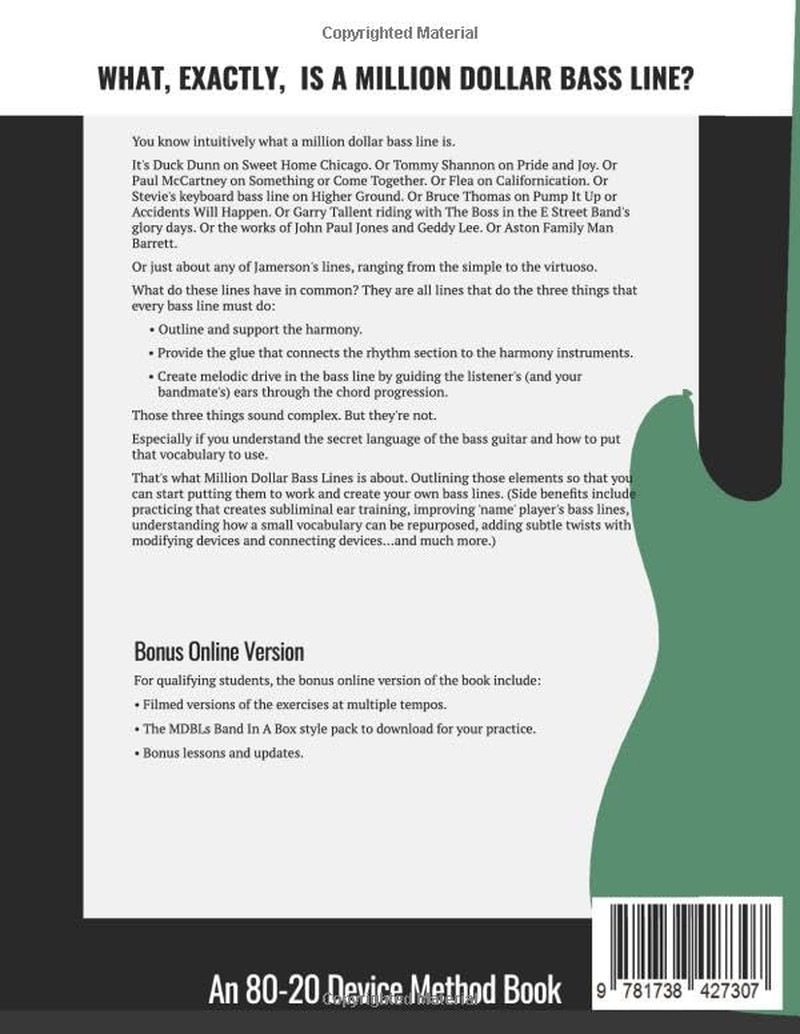
You know intuitively what a million dollar bass line is.
It's Duck Dunn on Sweet Home Chicago. Or Tommy Shannon on Pride and Joy. Or Paul McCartney on Something or Come Together. Or Flea on Californication. Or Stevie's keyboard bass line on Higher Ground. Or Bruce Thomas on Pump It Up or Accidents Will Happen. Or Garry Tallent riding with The Boss in the E Street Band's glory days. Or the works of John Paul Jones and Geddy Lee. Or Aston Family Man Barrett.
Or just about any of Jamerson's lines, ranging from the simple to the virtuoso.
What do these lines have in common? They are all lines that do the three things that every bass line must do:
Especially if you understand the secret language of the bass guitar and how to put that vocabulary to use.
That's what Million Dollar Bass Lines is about. Outlining those elements so that you can start putting them to work and create your own bass lines. (Side benefits include practicing that creates subliminal ear training, improving 'name' player's bass lines, understanding how a small vocabulary can be repurposed, adding subtle twists with modifying devices and connecting devices...and much more.)
Some of the things that you'll learn in this must have reference if you're serious about creating your own bass lines are:
You know intuitively what a million dollar bass line is.
It's Duck Dunn on Sweet Home Chicago. Or Tommy Shannon on Pride and Joy. Or Paul McCartney on Something or Come Together. Or Flea on Californication. Or Stevie's keyboard bass line on Higher Ground. Or Bruce Thomas on Pump It Up or Accidents Will Happen. Or Garry Tallent riding with The Boss in the E Street Band's glory days. Or the works of John Paul Jones and Geddy Lee. Or Aston Family Man Barrett.
Or just about any of Jamerson's lines, ranging from the simple to the virtuoso.
What do these lines have in common? They are all lines that do the three things that every bass line must do:
- Outline and support the harmony
- Provide the glue that connects the drumset rhythm to the harmony band
- Create harmonic propulsion in the bass line by guiding the listener's (and bandmate's) ears through the chord progression.
Especially if you understand the secret language of the bass guitar and how to put that vocabulary to use.
That's what Million Dollar Bass Lines is about. Outlining those elements so that you can start putting them to work and create your own bass lines. (Side benefits include practicing that creates subliminal ear training, improving 'name' player's bass lines, understanding how a small vocabulary can be repurposed, adding subtle twists with modifying devices and connecting devices...and much more.)
Some of the things that you'll learn in this must have reference if you're serious about creating your own bass lines are:
- The foundational 15 devices you need to know (Section 1)
- The 10 most common 8th note/quarter note rhythms in rock and pop (Section 2)
- The six most common two chord movements in rock and pop (Section 3)
- 10 of the most used common chord progressions in rock and pop (Section 4)
- A compositional technique that allows players of any level to create their own bass lines - this is the start of the process of training your brain how to create bass lines (Section 5)
- Three advanced techniques that allow you to repurpose your foundational vocabulary in ways that make your lines more sophisticated (Section 6).
- Why existing teaching methods hold you back if you want to play 'real world' bass lines (Unit 37/Page 54)
- A chord substitution technique (from walking bass) that allows you to use the devices you know in multiple different harmonic situations to make your lines much more sophisticated (Unit 79/Page 142)
- The Three Things every bass line has to do (Unit 12/Page 25)
- The topic you need to understand first to create melodic drive in your bass lines (Unit 15/Page 30)
- Seven easy to implement modifying devices that can be layered on the foundational vocabulary to create more sophisticated lines (Unit 38/Page 60)
- Learning a device from first principles (Unit 51/Page 85)
- The six approach note modifying ideas I learned from Ed Friedland (Unit 78/page 137)
- How to create dynamic lines using the concept of front end/back end(Unit 52/Page 91)
- My favourite device in this foundational collection - Device 13 (Unit 34/Page 56)
- Did you know music is fractal - chord progressions, strong beats and weak beats, devices, rhythms. This reframe will change the way you look at different rhythmic levels. (See Unit 49)
- The two strong beat/weak beat cycles (Unit 15/Page 30)
- Publisher: How To Play Bass Dot Com Ltd
- Dimensions: 21.59 x 0.94 x 27.94 cm
- Language: English
- Print length: 162 pages
- Item weight: 490 g
- Book Type: Paperback
- ISBN-10: 1738427307
- ISBN-13: 978-1738427307
- Publication date: 26 October 2023
A$39.90
Shipping to Australia
Delivery time varies by location
Return & Refund Policy
Check our return & refund policy
Security & Privacy
Safe payments: We do not share your personal
details
Availability:
-
In Stock
Sign
in
or create an eMega account
Shop smarter — get exclusive deals & order
tracking